

 English
 عربى


You pull a sheet of plastic wrap off the roll and instead of landing on the bowl it curls around your forearm and stays there. Peel it away and it snaps straight back. Nothing about the film is sticky in the glue sense, and your arm is not magnetic. What you are fighting is an electrical charge that the film has no way to release.
The short answer: polyethylene is an electrical insulator, with a surface resistivity around 10^16 to 10^17 ohm per square. Peeling it from the roll creates friction, friction moves electrons from one surface to the other, and because the film cannot conduct, that charge sits on the surface until something conductive comes close. Warm, slightly moist skin is exactly that something.
Dry air makes it worse, thin gauge makes it worse, and fast peeling makes it worse. Raise the humidity above roughly 40 percent, slow the peel down, and discharge yourself against a grounded metal surface, and most of the cling is gone in seconds.
The rest of this page explains the mechanisms behind cling, why your arm attracts film more than a ceramic bowl does, which household fixes hold up, and how the same effect behaves on a packaging line running kilometers of film per shift.
Why plastic wrap grabs your arm: the triboelectric effect in plain terms
When two different materials touch and then separate, electrons can move from one surface to the other. This is the triboelectric effect, the same physics that lets a balloon pick up hair. Polyethylene sits toward the negative end of the triboelectric series, so when film is unwound from a roll or dragged across a metal roller, the film surface tends to collect extra electrons while the surface it left behind is left positive.
Unwinding separates surfaces continuously, meter after meter. Potentials of several thousand volts are routine during unwind with very little current behind them, which is why you feel a light snap rather than a shock. The real problem is that the charge has nowhere to go. A polyethylene surface can hold it for minutes or hours in dry air, because there is no conductive path for it to leak away.
Your skin closes that path. Skin carries moisture and salts, so it behaves far more like a conductor than film does, and your body acts as a small capacitor to ground. The charged sheet moves toward the nearest conductive surface, and if your forearm is closer than the countertop, that surface is your arm. Fine arm hair helps too, because each hair concentrates the field at its tip.
Four mechanisms, and only one of them is static
People call all of it static cling, but four different things can hold a sheet of film in place. Knowing which one you are dealing with tells you which fix is worth trying.
| Mechanism | What drives it | Where you notice it |
|---|---|---|
| Triboelectric charge | Friction during unwinding transfers electrons and the insulator holds them | Film jumps to arms and hair, attracts dust, crackles; worst below about 40 percent relative humidity |
| Van der Waals forces and trapped air | Two very smooth surfaces push the air out between them and molecular attraction takes over | Film grips glass, ceramic and stainless steel counters, especially when pressed flat |
| Capillary moisture bridging | A microscopic water film forms bridges between the two surfaces | Sticks to warm bowls, damp hands and wet countertops; releases when things dry or get hot |
| Formulated tack | Cling resins or tackifiers are added to the film on purpose | Clings in any direction and any humidity, including to itself |
On your arm, the first row explains almost everything. On a bowl, the second and third rows usually do.
Why dry air turns an occasional annoyance into a daily one
Charge decay is a race between how fast charge builds and how fast the surface can shed it. Water molecules in the air adsorb onto a polymer surface and form a thin, weakly conductive layer. At 50 percent relative humidity that layer drains a film surface in seconds. At 20 percent, decay times stretch into minutes, which is longer than anyone spends wrapping a sandwich.
Temperature matters indirectly, because dry air dries skin and dry skin holds charge longer. Synthetic clothing makes it worse again: a fleece sleeve brushing against the roll recharges the film every time you move, which is why the same box of wrap behaves differently depending on what you are wearing.
Seven fixes that work, ranked by how fast they help
- Discharge yourself first. Touch a grounded metal object such as a tap, a fridge door or a metal sink rim for a second before you handle the film. That drains the charge your body picked up walking across the floor, and it is the fastest fix available.
- Slow the peel down. Most of the charge is generated during separation. Pull the sheet off at a shallow angle and let it fall onto the container instead of handling it in open air.
- Keep the film doubled. Fold the sheet so the two freshly separated faces press against each other before it gets near your arm. The charged faces neutralize in contact and the outer surfaces carry far less net charge.
- Wipe your hands with a damp cloth. A trace of moisture on the skin gives the charge somewhere to go and reduces the attraction for a few minutes.
- Raise the humidity in the room. Anything from 40 to 60 percent relative humidity is enough. A humidifier, a pot of water simmering on the stove, or simply wrapping food straight after cooking helps.
- Change what you stand on and wear. Carpet and rubber-soled shoes insulate you from ground, while cotton sleeves and a hard floor reduce recharging.
- Use a different film for the job. Thicker gauge film resists curling better, and a film without cling additives will not grab at all. Cling film clings because that behavior is formulated into it, not because the plastic is better.
The same effect at scale: static on a packaging line
The cling on your arm is a small version of a problem packaging engineers deal with every shift. As film unwinds, charge builds on the web, and at production speeds the surface potential can reach tens of kilovolts. The symptoms are consistent enough to diagnose from a shift log.
- The web is pulled toward rollers, frames and machine guards instead of tracking straight.
- Dust, powder and film fragments are attracted into the seal area, producing weak or contaminated seals.
- Printed webs drift in register, and stacked layers block together on the roll and refuse to unwind cleanly.
- Pre-made bags stick to each other on filling lines, so suction cups and air jets fail to open them.
- Operators take repeated shocks when they touch the machine frame.
Standard countermeasures are humidity held between 45 and 55 percent, ionizing bars at the unwind and ahead of the sealing station, solid machine grounding, and a tapered tension profile so the web is never pulled harder than it needs to be. Internal antistatic additives are common in films that will be handled quickly, because they migrate slowly to the surface and give the charge a path to ground.
Bag opening is where static becomes most visible to the end user, and pre-made bags that refuse to separate slow a filling line down more than any tracking fault does.
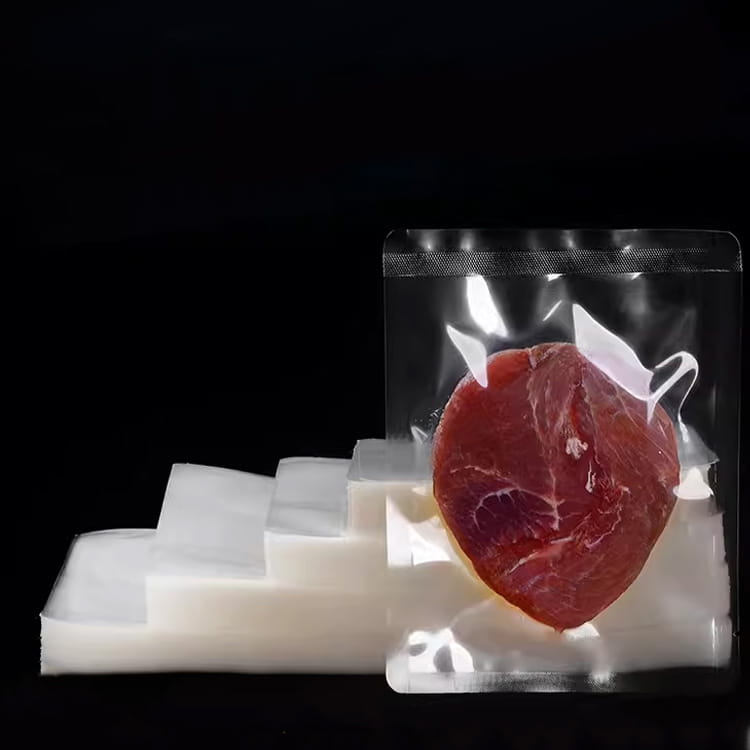 High-Barrier PE/PA Composite Vacuum Sealer Bags for Fresh FoodFor filling and freezing workflows, these PE/PA vacuum sealer bags provide oxygen and moisture barrier, low-temperature toughness, and reliable heat sealing.View Product →
What to specify if static is a real problem in your process
For household wrap, the fix is humidity and handling. For anyone buying film by the pallet, static behavior is a specification, and three variables control most of it.
Gauge and gauge tolerance
Thinner film has lower stiffness and charges faster, so it curls and blocks more readily. A tight gauge tolerance, usually expressed as a percentage of nominal, keeps stiffness and friction predictable from roll to roll instead of drifting batch to batch.
Slip level and coefficient of friction
Slip additives lower the coefficient of friction so the web slides over rollers and into forming shoulders without dragging. Form-fill-seal films commonly run with a kinetic coefficient of friction in the 0.2 to 0.4 range, and the exact target depends on the machine, the bag format and how fast the line runs.
Antistatic package and layer placement
In a multilayer structure, antistatic and slip additives can be placed in one specific layer rather than spread through the whole film, which keeps seal integrity intact while still controlling charge. Resin choice matters here as well, since LDPE, LLDPE and HDPE differ in stiffness, seal behavior and surface energy, and the blend decides how the finished web behaves on the machine.
For low-temperature forming and sealing work, where the film has to run flat and open predictably, a symmetric seven-layer PA/PE structure is a common starting point:
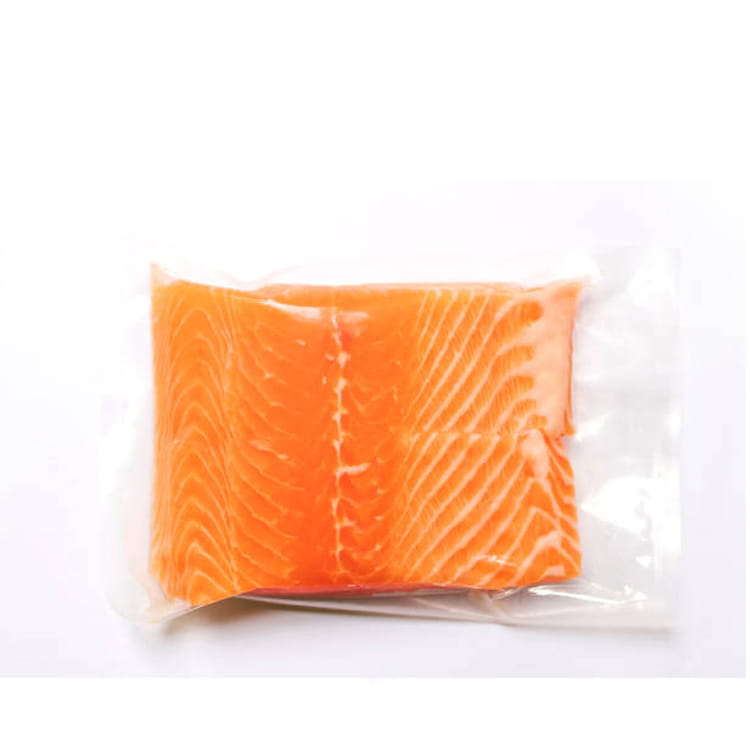 7-Layer Clear Vacuum Sealer Bags for Freeze-Dried FoodsFor low-temperature forming and sealing, these seven-layer PA/PE bags offer moisture and oxygen barrier for freeze-dried foods and sensitive products.View Product →
When the same line also needs an oxygen barrier, a seven-layer high barrier construction handles the gas side of the job while the outer layers manage slip and charge:
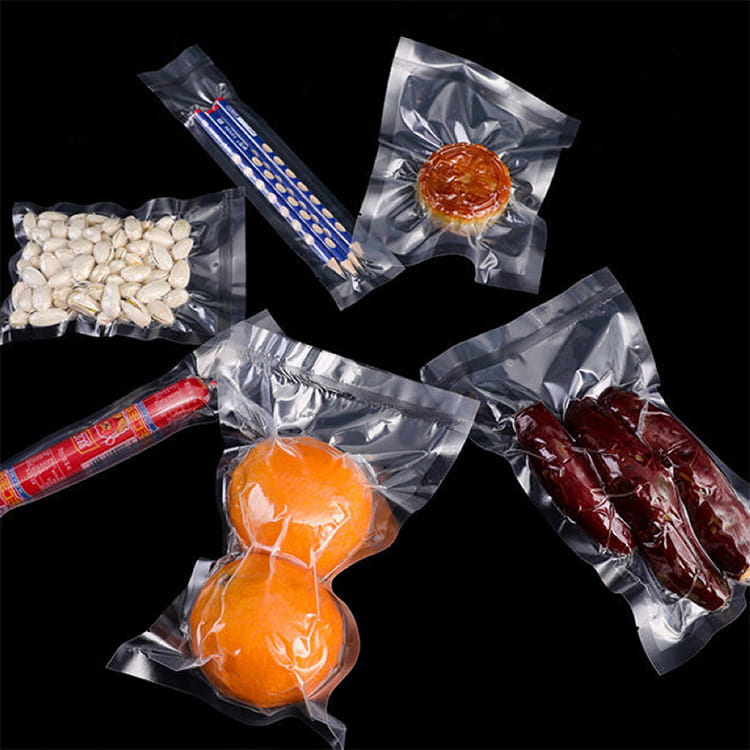 7-Layer Transparent Co-Extruded Barrier Packaging FilmThis seven-layer PA/PE/PP film uses EVOH for oxygen and moisture barrier, with strength and heat sealing for food and sensitive packaging.View Product →
Frequently asked questions
Q1: Why does plastic wrap stick to my arm but not to a glass bowl?
Skin is moist and salty, so it conducts and your body grounds the charge, which is why static does the grabbing. Glass is an insulator as well, so film clings there mainly through van der Waals forces and trapped air rather than electricity.
Q2: Does strong cling mean the film is higher quality?
No. Cling is a formulated property created with cling resins or tackifiers. Static cling is the unwanted version of the same attraction, and neither one tells you anything about barrier performance, seal strength or gauge consistency.
Q3: Can static from plastic wrap damage electronics or cause a fire?
A single household sheet carries very little energy and is not a realistic ignition source. In industrial settings where solvent vapors are present, static control is a genuine safety requirement, which is why those lines rely on grounding, ionization and humidity control rather than guesswork.
Q4: What is the fastest fix with nothing on hand?
Touch a grounded metal surface, then fold the sheet in half so the charged faces meet before it touches your arm. Those two steps solve most of the problem in a dry kitchen without buying anything.
Static cling is a surface phenomenon, not a defect. A polyethylene sheet that grabs your arm is behaving exactly as an insulator with nowhere to send its charge should behave, and the same physics shows up on a production line as dust in the seal, blocked rolls and bags that will not open.
The fixes are just as specific on both ends: humidity, ionization, grounding, and a film construction that puts slip and antistatic additives in the layers where they belong. That layer-by-layer control is exactly what multilayer coextruded film is built for, whether the finished web ends up wrapping a tray of meat or protecting a circuit board.