

 English
 عربى
عربى


1. The Oxygen Paradox in Meat & Cheese Preservation
For meat and cheese, oxygen is both an enemy and a necessity. While a minimal amount is required for colour stability in red meat, excessive permeation accelerates lipid oxidation, discolouration, and microbial growth. For cheese, oxygen triggers mould and off‑flavours. The solution lies not in eliminating oxygen entirely, but in controlling its ingress with precision. This is where high barrier co‑extruded multilayer films become indispensable.
Barrier performance comparison
Data from multiple industry studies confirm that multi‑layer co‑extruded film with EVOH can reduce oxygen transmission by up to 98 % compared to standard monolayer films, directly translating to 5‑7 extra days of shelf life for fresh sausages and semi‑hard cheeses.
2. Anatomy of a High Barrier Co‑extruded Structure
Unlike laminated films, co‑extrusion bonds multiple polymer layers in a single molten process. A typical 5‑ or 7‑layer structure includes:
- Sealing layer: PE or LLDPE – heat sealability, toughness.
- Adhesive tie layers: Modified polyolefins – bonding incompatible polymers.
- Barrier core: EVOH or PA – oxygen & aroma barrier.
- Outer structural layer: PA or PET – mechanical strength, puncture resistance.
This co‑extruded architecture eliminates adhesive delamination risks, ensuring consistent barrier performance even under high humidity or temperature fluctuations during cold chain logistics.
3. Shelf Life Extension: Real‑World Impact
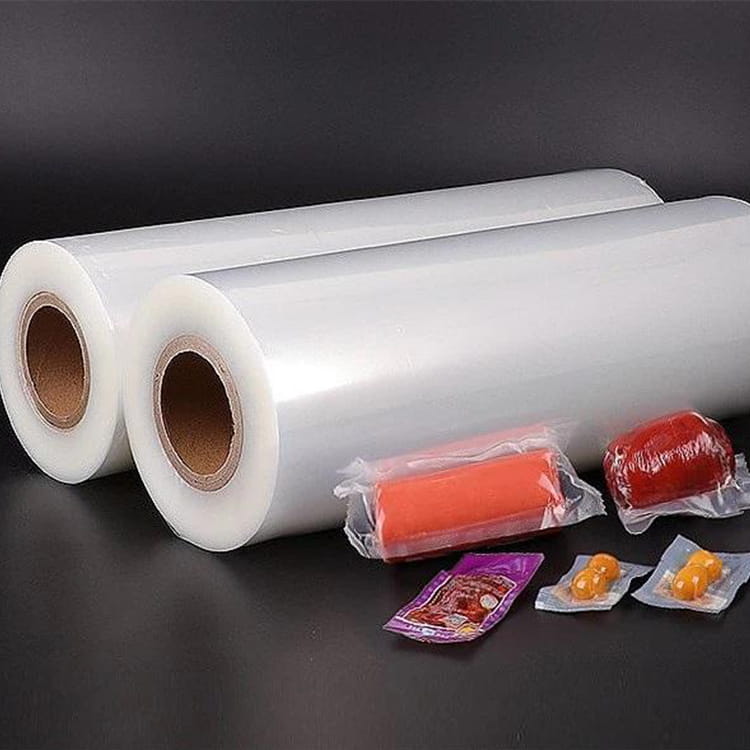
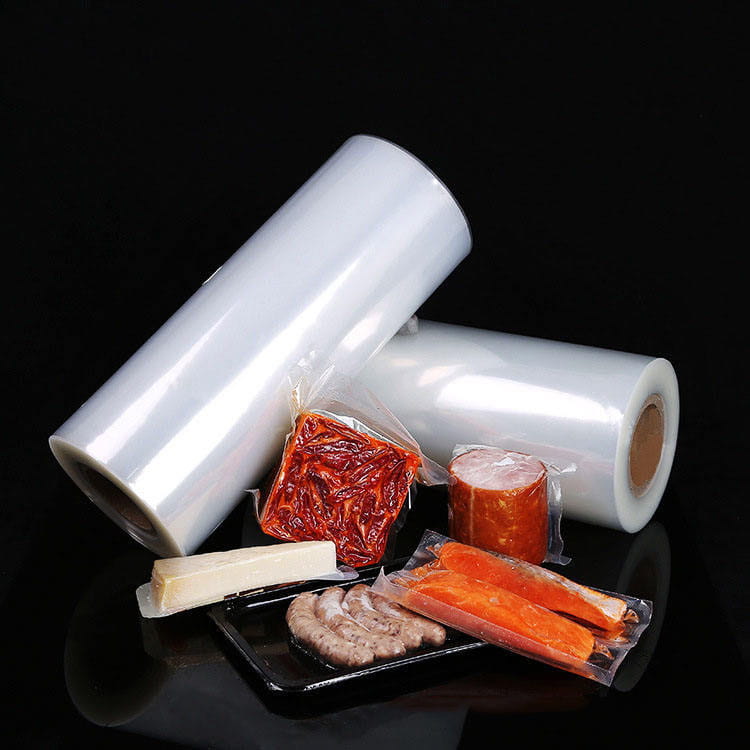
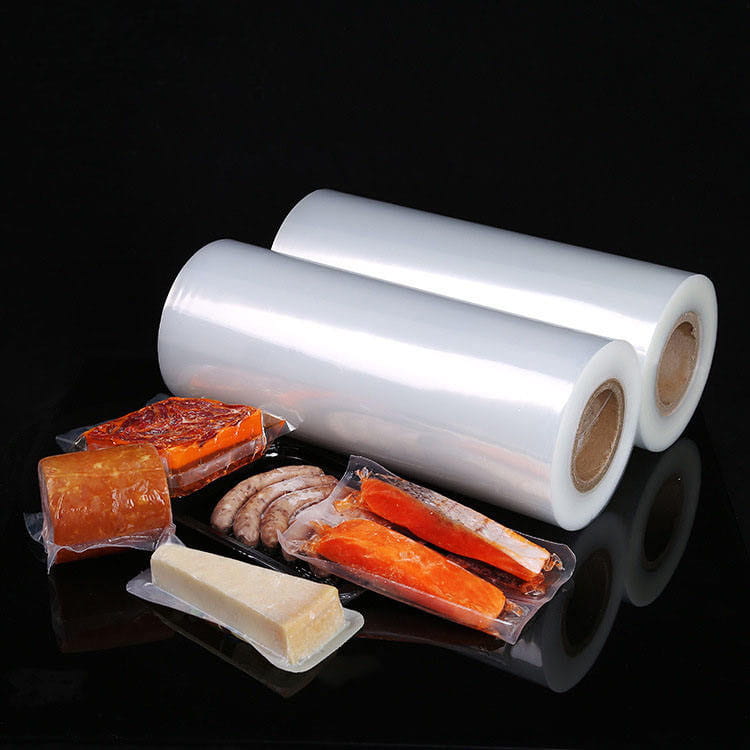
Independent trials on packaged sausages (vacuum skin packs) show that switching from standard PE to a high barrier co‑extruded cheese sausage meat packing plastic film increased the time to first spoilage from 18 to 26 days at 4 °C. For hard cheeses, the improvement is even more pronounced – up to 40 % longer mould‑free storage.
Shelf life gain by product type
4. Comparative Radar: Barrier, Mechanical & Economic Factors
When evaluating meat and cheese packaging materials, decision‑makers must balance barrier, toughness, seal integrity, and cost. The radar chart below contrasts a 7‑layer co‑extruded high barrier film against a conventional 3‑layer laminate.
The radar clearly shows that multi‑layer co‑extruded film outperforms laminates in oxygen barrier and puncture resistance, with only a moderate cost premium – often justified by reduced food waste.
5. Process Consistency: From Extruder to Packing Line
A multi‑layer co‑extruded film factory must control layer thickness uniformity within ±5 % to guarantee barrier performance. Advanced feedback systems using nuclear gauges and infrared sensors ensure that the EVOH layer remains continuous even at high line speeds (up to 300 m/min).
This precision translates directly to reliable cheese packaging materials, where even microscopic pinholes can cause premature mould. Co‑extrusion eliminates pinhole risks associated with adhesive lamination.
6. Economic & Sustainability Considerations
While the raw material cost of high barrier film is higher than standard PE, the total cost of ownership is often lower due to reduced product loss. A 2024 analysis of 8 medium‑sized dairies showed that switching to co‑extruded high barrier films reduced cheese waste by 12‑15 %, offsetting the film cost within 6 months.
| Parameter | Standard PE | High barrier co‑extruded |
|---|---|---|
| O₂ TR (cc/m²·day) | ~180 | < 2 |
| Moisture WVTR (g/m²·day) | ~12 | ~3 |
| Puncture resistance (N) | 12 | 28 |
| Avg. shelf life (cheese) | 45 days | 68 days |
| Cost index (per m²) | 1.0 | 1.6 |
Furthermore, modern co‑extruded films are fully recyclable (PE‑based structures) and can incorporate post‑industrial recycled content without compromising barrier performance – a key advantage for brands aiming for circular packaging.
7. FAQs on High Barrier Co‑extruded Films
Q1: What is the main difference between co‑extruded and laminated barrier films?
Co‑extruded films are produced by melting and bonding multiple polymers in a single die, creating a permanent, delamination‑free interface. Laminated films use adhesives to join pre‑made layers, which can degrade over time or under high humidity.
Q2: Can high barrier films be used for both vacuum and modified atmosphere packaging?
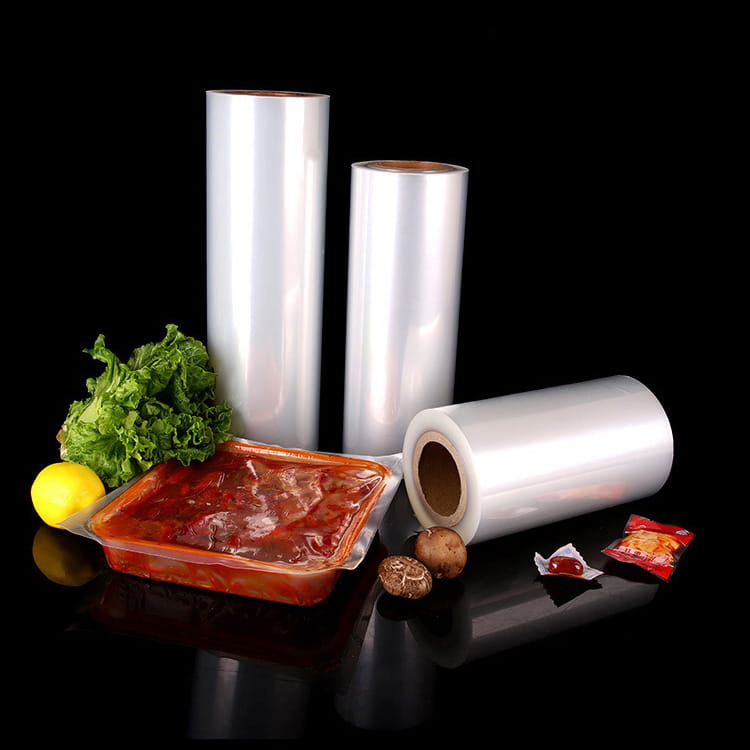
Absolutely. Their excellent oxygen barrier and seal integrity make them ideal for vacuum skin packs, MAP (high CO₂), and even shrink bags for whole muscle meats and cheese blocks.
Q3: How does EVOH perform under high humidity conditions?
EVOH is hygroscopic – its barrier drops at high RH. However, in a co‑extruded structure, EVOH is sandwiched between moisture‑insulating polyolefin layers, maintaining O₂ barrier below 5 cc/m²·day even at 90 % RH.
Q4: Are these films suitable for microwave or sous‑vide heating?
Yes, many co‑extruded structures include high‑temperature resistant layers (PA/PP) that withstand boiling water and microwave reheating without warping or leaching.
Q5: What thickness range is typical for meat and cheese packaging?
Standard thicknesses range from 60 to 150 µm, depending on the application. Sausage casings are thinner (60‑90 µm), while cheese vacuum bags are often 100‑150 µm for extra puncture resistance.